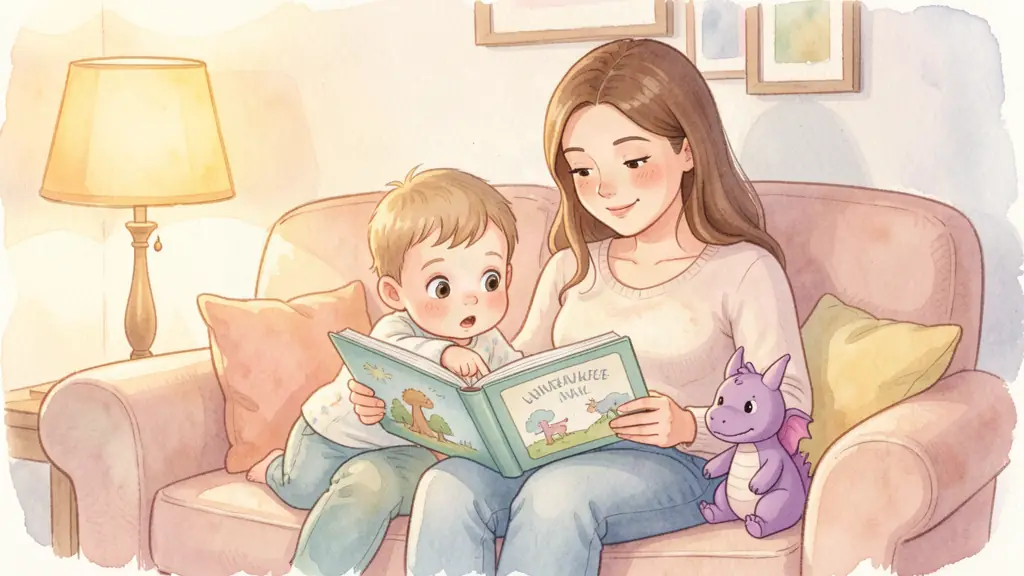
There's a moment, and you'll know it when it happens, where your child stops trying to eat the book and starts trying to tell you what's on the page. Maybe they point at a dog and say "woof." Maybe they gasp at exactly the same spot every single time, even though they know the bear isn't really hiding. That's the moment. That's when you realise they're not just looking at pictures anymore. They're following a story.
I remember it clearly with my youngest. We'd been reading the same board book for what felt like months — one of those indestructible ones with the rounded corners and the crinkly page. And then one evening she pushed it away, reached for Who Sneezed Glitter instead, and sat perfectly still through the whole thing. Not chewing the cover. Not flipping ahead. Just... listening. I nearly cried.
But here's what I want to say upfront: there's no magic age for this. Some children are ready at 18 months. Others don't care about narratives until they're three or even four. That's completely normal. What matters is watching your particular child, not the milestones chart on the fridge.
They ask for the same book again (and again, and again)
Repetition in toddlers isn't a bug, it's the whole system working. When a child wants to hear the same story for the fifteenth time in a row, they're not being stubborn. They're building. Each reading gives them a chance to anticipate what comes next, to fill in words they missed last time, to feel the rhythm of how a story moves from beginning to end.
My daughter went through a phase where Count Along with Poppy had to be read three times before bed, minimum. Not once did she lose interest. By the tenth reading she was finishing the counting sequences herself. By the twentieth she was correcting me when I skipped a page (which I did on purpose, I swear, to see if she'd notice. She always noticed).
If your toddler is pulling the same book off the shelf and bringing it to you with that unmistakable "read this NOW" expression, they're telling you something. They've found a story that matters to them. That's readiness.
They react to what happens, not just what they see
There's a difference between a child who points at a colourful picture and says "pretty!" and a child who looks worried when the character looks worried. The second child is responding to the narrative, not just the images.
Watch their face during a story you've read before. Do they anticipate the funny bit? Do they look tense during the bit where something goes wrong? When Poppy sneezes glitter everywhere in Who Sneezed Glitter, does your child laugh because they knew it was coming? That anticipation means they're tracking the emotional arc of the story. They understand, on some level, that stories have shape.
This is one of those things that's easy to miss if you're not looking for it. I certainly missed it with my eldest for a while. I thought he was just sitting nicely. Then I noticed he was biting his lip during the bit where Poppy feels embarrassed. He was feeling it alongside her. That's when I knew he was ready for longer, more involved stories.
They start "reading" to their toys
This is the one that gets me every time. You walk past the playroom and hear your toddler muttering to a teddy bear in a sing-song voice, turning the pages of a book and narrating something that sounds vaguely like the story you read them last night. Except it's got bits that definitely weren't in the original. Maybe the dragon flies to the moon. Maybe the colours talk to each other.
This is narrative play, and it's a wonderful sign. Your child isn't just absorbing stories anymore. They're making their own. The structure of beginning, middle, and end is taking root in their mind, and they're experimenting with it.
I used to write down the versions my daughter told her stuffed animals. Some of them were genuinely better than what I'd written. I'm not even being modest. A three-year-old's version of a story about a dragon who lost her favourite colour involved a trip to the moon and a conversation with a cloud, and honestly? I should have taken notes for the next book.
They want to know "what happens next"
This is the big one. When a child looks up at you after you've turned the last page and says "but what happened to the —" or "did she find her —" or even just "more," they've crossed a line. They're invested in the characters. They want the world of the story to continue beyond the final page.
With Colours of the Rainbow, which is one of our simpler books, I didn't expect this kind of reaction. But parents have told me their children ask where Poppy goes after the book ends. Where does she sleep? Does she dream in colour? These aren't questions about pictures. They're questions about a character who has become real to them.
That's the moment when a book stops being a collection of pages and becomes a world your child can visit. And once they know they can visit a world in a book, they'll want to visit more of them.
They sit through a whole story without wandering off
I put this one last because it's the most obvious and also the least important on its own. Attention span varies wildly between children, and a toddler who can't sit still during a book isn't behind. They might just be a mover. My eldest was. He listened to stories while building towers, while crawling under tables, while spinning in circles. He was paying attention. His body just needed to be doing something else at the same time.
But if your child has started settling into your lap and staying there — really staying, not just physically present while mentally somewhere else — that's a strong sign they're engaged with narrative. They've found the story interesting enough to be still for.
The tricky part is distinguishing between "sitting because they're captivated" and "sitting because the TV is on and they're zoning out." You know your child. Trust yourself on this one.
A note about not rushing it
I know there's pressure, subtle or otherwise, to push children toward "real" books as early as possible. As if board books are babyish and picture books are the goal and chapter books are the real prize. I don't buy into that hierarchy, and I wrote the Poppy series specifically so that even the simplest books — Colours of the Rainbow, Count to 10 — have little narrative threads woven through them. A story can be simple and still be a story.
When your child is ready, they'll show you. Probably by grabbing a book out of your hands and demanding you read it properly this time. In the meantime, chewed corners and crinkled pages are not a sign of failure. They're a sign of a child who loves books in the way that makes sense to them right now.
And if you're looking for a good first "real" story, Who Sneezed Glitter was written for exactly this moment. It's got enough going on to hold a toddler's attention, a proper beginning-middle-end structure, and a dragon who sneezes sparkles. What more could you want?