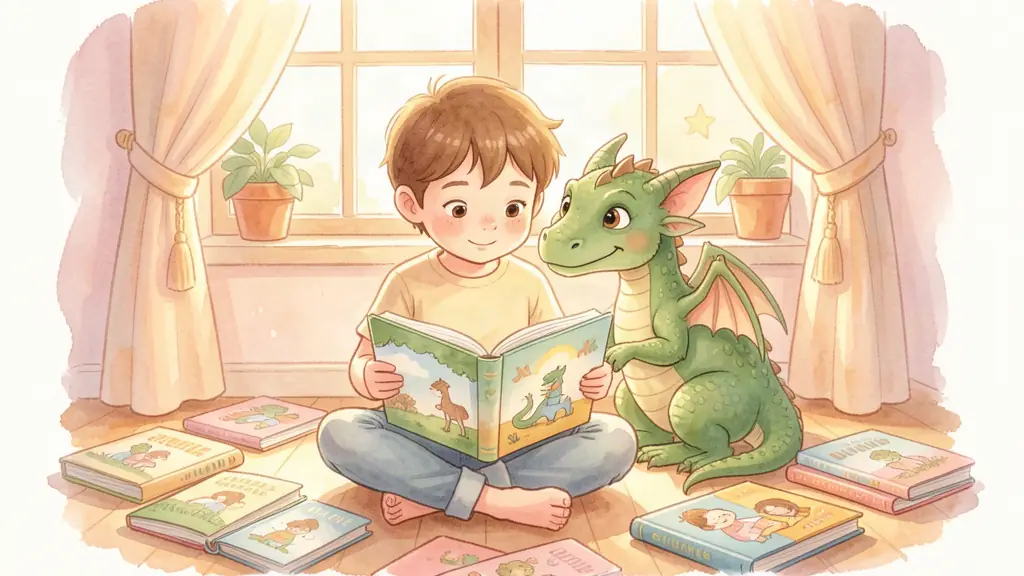
A few weeks ago, I was at a school in Bristol, reading Who Sneezed Glitter? to a class of four-year-olds. I got to the page where Poppy sneezes and sends a cloud of sparkles across the garden. One girl in the front row, completely deadpan, looked at me and said, "My cat does that. But with hairballs."
That's the sort of thing you can't plan for. And honestly? It's the sort of thing that's made me a better writer.
I didn't set out to learn from children. When I started writing the Poppy series, I thought I already understood my audience. I'd read the research. I knew about vocabulary ranges for toddlers, about how repetition helps with language acquisition, about the importance of rhythm in picture books. All useful, all true. But it turns out that sitting in a room full of three-year-olds while you read your own work back to them is a completely different education.
The first lesson: they don't care about your clever bits
There's a line in Colours of the Rainbow where Poppy discovers a patch of purple flowers. I spent ages on that page. The illustration took weeks. I chose every word carefully, trying to capture that specific feeling of stumbling onto something beautiful when you're out walking.
A toddler at a library reading pointed at the page, said "flowers," and turned to the next one.
That's it. Flowers. Next.
It stung for about thirty seconds, and then I realised something important. The children who loved the book didn't love it because of any individual page. They loved the rhythm of it. The way one colour flows into the next. The pattern. I'd been so focused on the details that I'd nearly missed the thing that actually held the whole book together.
I think about that toddler regularly. She taught me to stop trying so hard on the clever bits and pay more attention to the shape of the whole thing.
Repetition isn't boring to them
This was a hard one for me to accept. As an adult, I find repetition tedious. If I read the same sentence structure three times in a row, my brain starts looking for variety. So when I wrote Count to 10, I kept trying to change things up. Different phrasings for each number. Different ways of presenting the count.
My editor gently pushed back, and I'm grateful she did. But the real confirmation came from the children themselves. The kids who connected most strongly with Count to 10 were the ones who wanted to read it again. Immediately. And again after that. They weren't bored by the repetition. They were powered by it.
There's a particular joy in watching a two-year-old anticipate what comes next on a page. Their whole body leans forward. Their mouth moves before you've said the words. That's not boredom. That's mastery. They're practising, and the repetition is what lets them do it.
When I wrote Count Along with Poppy, I leaned into this deliberately. Same structure, same rhythm, page after page. It felt wrong at first, like I was being lazy. But the children disagreed. Loudly.
They tell you the truth about your pictures
Adults are polite about illustrations. They say things like "Oh, that's lovely" or "What beautiful colours." Children have no such filter.
At one school visit, a boy pointed at Poppy and said, "Why does the dragon look scared?" I hadn't intended Poppy to look scared. I'd drawn her with wide eyes because she was surprised. But to this boy, wide eyes meant frightened. I went home and looked at the illustration again. He was right, or at least he had a point. I've been more careful about facial expressions since then.
Another child told me that the sky in one of my paintings "wasn't the right blue." I asked her what the right blue was. She pointed out the window. Fair enough.
Children read pictures with an intensity that most adults have moved past. They notice when a character's hands are in a weird position. They notice if the proportions are slightly off. They notice if a page feels different from the one before it, even if they can't articulate why. Watching them read my books is like getting a live focus group with absolutely no filter whatsoever.
The questions they ask
When I visit schools, I always leave time for questions. The adults in the room expect questions about where I get my ideas or how long a book takes to write. The children have different concerns entirely.
"Does Poppy have a mum?"
"Where does Poppy sleep?"
"Can Poppy fly?"
"Why did Poppy sneeze glitter? Is she ill?"
These questions matter because they show me what the children have actually absorbed. They've built a world around Poppy. They want to know things about her life that aren't in the books. That's the goal, isn't it? A character who feels real enough that children wonder about them when the story's over.
But the questions also push me to think more carefully about what I leave out. In Who Sneezed Glitter?, I never explain why Poppy sneezes glitter. It just happens. Several children have asked about it, and I've started to think that maybe the next book should address that. Not because the story needs it, but because the readers clearly want to know.
They have their own stories
The thing that surprises me most at school visits is how many children want to tell me their own stories about dragons. Or about cats. Or about their grandma's garden. One girl spent five full minutes describing a dragon she'd invented who could turn invisible but only on Tuesdays. It was brilliant.
I've started listening more carefully to these stories because they reveal what children find interesting. Not what I think they should find interesting, but what genuinely catches their imagination. The invisible-on-Tuesdays dragon told me more about what a four-year-old finds fascinating than any amount of market research could.
Sometimes their stories end up influencing my work in small ways. I can't always trace the connection directly, but I know that the more time I spend listening to children talk about their own imaginary worlds, the better I get at building ones that feel right to them.
What I've actually learned
If I had to sum it all up, I think the biggest lesson is this: children are not a simplified version of an adult audience. They're a completely different kind of reader. They bring different expectations, different attention spans, and different standards. They don't need me to write down to them. They need me to write towards them, which is a different thing entirely.
The books that work best are the ones where I stopped worrying about what I thought was clever and started paying attention to what the children actually responded to. Colours of the Rainbow works because the rhythm is steady and the colours are vivid and right. Count to 10 works because the repetition gives children something to grab onto. Who Sneezed Glitter? works because, well, glitter sneezes are apparently hilarious to small humans. Who knew.
I'm still learning. Every school visit, every letter from a parent, every photo of a toddler holding one of my books upside down — all of it teaches me something. The children are the best editors I've ever had. They just don't know it.
If you'd like to share how your little ones have responded to Poppy's adventures, I'd love to hear about it. There's a contact page on the Sparkle Tree Press website where you can reach me. The stories parents share often end up shaping the next book more than they realise.