It started with a cough.
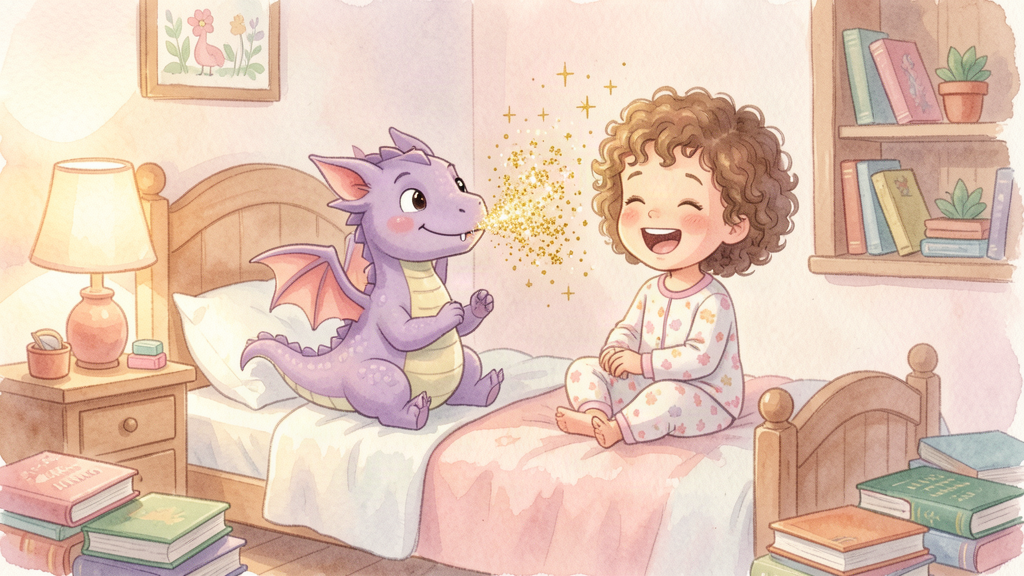
My daughter Rosie was three, tucked into bed with a cold that had been hanging around for about a week. She'd been watching a nature documentary earlier that afternoon — the one with the komodo dragons — and somewhere between "goodnight" and "I need water" and "one more story," she asked me: "Mummy, do dragons get colds?"
I said yes, obviously. Because in our house, dragons get everything. They get colds and tummy aches and sometimes they need a plaster for their elbow (don't ask me where a dragon's elbow is — I've given up trying to map dragon anatomy). So yes, dragons get colds.
"What happens when they sneeze?" she asked.
And I said the first thing that came into my head: "Glitter."
She laughed so hard she actually did sneeze, which made us both laugh harder, and by the time I'd got her settled again I was already thinking about it. A dragon who sneezes glitter. Not a powerful, fearsome dragon. Not a dragon with an Important Lesson to teach. Just a dragon with a really inconvenient magical affliction.
What grabbed me about the idea
I'd been wanting to write a children's book for a while. Years, actually. I'd made a few false starts — stories about brave princesses, stories about talking animals, the usual. None of them felt like mine. They felt like I was writing a version of something I'd already read, which is a miserable feeling.
But that night, lying in bed thinking about a glitter-sneezing dragon, something clicked. I think it was the mess of it. Poppy — she wasn't Poppy yet, she was just "the dragon" — wasn't trying to be magical. The magic was a problem. She sneezed at the worst moments. It got on everything. She couldn't control it.
That felt real to me. Not dragon-real, obviously. But the feeling of your body doing something embarrassing and uncontrollable while you stand there trying to pretend it didn't happen? Every child knows that feeling. Every adult does too, if we're honest.
Building Poppy's world
Once I had the character, the world came together faster than I expected. If you've read Colours of the Rainbow, you'll know that Poppy's sneezes aren't just sparkly — they're colourful. Each sneeze is a different colour, which became the backbone of the first book. It was a natural fit for a board book aimed at very little ones. Babies and toddlers are already obsessed with colours, so a dragon who literally sneezes them out felt like it might work.
The counting books came next. Count to 10 and Count Along with Poppy grew from watching Rosie count everything in sight — stairs, peas, her own fingers (always the same fingers, always the same count). I wanted the counting to feel like part of Poppy's world rather than a maths lesson bolted onto a story. So Poppy sneezes one glitter puff, then two, then three, and the objects around her accumulate in a way that's hopefully funny enough that children don't realise they're practising numbers.
Who Sneezed Glitter was the one where I felt like I was really writing, not just making a board book. It's for slightly older children, ages three to seven, and it's a proper story with a beginning, a middle, and a mystery. Someone in the enchanted forest has been sneezing glitter everywhere, and the other animals are trying to work out who it was. Poppy, naturally, is trying very hard not to give herself away.
I had the most fun writing that one. There's something deeply satisfying about writing a character who is terrible at hiding the thing everyone is looking for.
The illustration side
I should say — I don't illustrate the books myself. I can barely draw a convincing stick figure. But I'm closely involved in how Poppy looks, and I spend a lot of time with the illustrators talking about colour palettes and expressions and the specific shade of purple that feels right for Poppy's scales.
The watercolour style was a deliberate choice. I wanted the books to feel soft and warm, not sharp and digital. When you hold a picture book, you're usually sharing it with a child who is very close to you — on your lap, in bed, pressed against your side. The illustrations should feel like that closeness. Watercolour does that. It bleeds at the edges. It has warmth in it. You can see the brushstrokes if you look carefully, and children do look carefully, more carefully than most adults give them credit for.
Rosie once spent four minutes studying a single page of Colours of the Rainbow and then told me, very seriously, that Poppy's left eye was "a tiny bit more happy than her right eye." I still don't know what she meant. But she was right that the eyes were slightly different, and I've never looked at that illustration the same way since.
Why the sneeze matters
People sometimes ask me why I didn't just write about a dragon who breathes fire or flies or does any of the normal dragon things. The honest answer is that those stories have been told already, and told well. I didn't have anything new to add to "dragon breathes fire."
But a dragon who sneezes glitter? That I could work with.
There's a moment in Who Sneezed Glitter where Poppy is trying to keep her sneeze in during a very quiet moment, and she fails, and glitter goes everywhere, and she's mortified. I've read that page at school visits maybe twenty times now, and every single time, at least one child in the audience says "that happens to me." Not the glitter part. The other part. The trying-to-hold-it-in-and-failing part.
That's why the sneeze matters. It's not really about magic. It's about the things that come out of us that we can't control, and learning that those things might actually be the best parts of who we are.
Rosie is six now and has mostly grown out of the cold that started all of this. She still fake-sneezes glitter when she wants to make me laugh. It still works.
Poppy's next adventure is taking shape in my notebook. I won't say too much yet, but it involves rain, and it involves a problem that can't be solved by sneezing. Which, for Poppy, is a problem indeed.