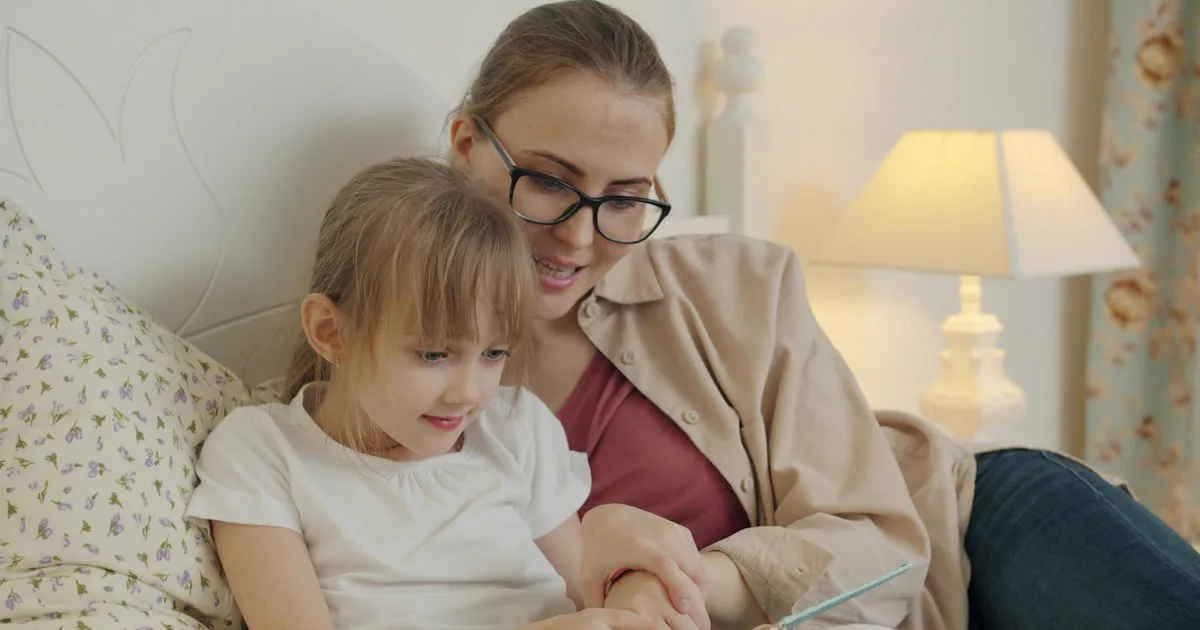
We started with a bedtime chart, because that is what the books said to do. Bath at seven, teeth at quarter past, stories at half past, lights out at eight. It was colour-coded and stuck to the fridge like a train timetable for somebody who cannot tell the time. It lasted four nights. On the fifth, a tantrum about which pyjamas had legs on ran straight through every slot on it, and the chart came down.
What replaced it has no clock in it at all. It has an order: bath, pyjamas, teeth, two stories, one song, lights. Eighteen months later my youngest can recite that sequence back to me, in order, including the steps she still argues about. That is the whole trick. Bedtime sticks when it is a sequence, not a schedule.
Order beats the clock
A fixed time is fragile. Dinner overruns. Grandparents turn up. One sock goes missing at exactly the wrong moment and suddenly the evening is behind schedule and everyone is upset about a thing that only ever existed on the fridge. A fixed sequence bends instead. When we are running late we skip the bath. We have never once dropped the story, and the children know the difference.
There is a plainer reason too. "Two stories, then the song" is something a three-year-old can hold in their head. "Bedtime is at seven" is not. When the steps are fixed, a child can see what is coming and how much of it is left, and most of the negotiating stops. Ours still negotiates about the song. That is fine, because the song is the last step, so the argument is nearly over by the time it starts.
The order also travels. A hotel room, a blow-up mattress at Nana's, a tent that leaks: the bath might be a flannel and the bed might be on the floor, but the sequence is identical. In an unfamiliar place, a familiar order is worth more than any chart I ever printed.
Choose two or three books and leave the rest on the shelf
The biggest change we made was to stop offering the whole shelf at bedtime. A small stack lives on the crate by the bed, two or three books at a time, and the choice is made from that. Choosing from six books takes fifteen minutes and ends in tears. Choosing from three takes twenty seconds.
Expect the same book every night for a fortnight. That is the routine working. We have written before about what repeated reading is doing inside a small head: the fluency and the confidence that come from a story worn smooth by use. The stack is small precisely so that repetition happens. A child who knows every page turn of the top book is a child who can relax into being read to. And if you are still working out whether your toddler is ready for a real story at all, that is a different question, and we have written about that one too.
Swap one book every week or two, not every night. New books land better when they arrive in a familiar frame. And if you cannot bear the current top book any more, put it at the bottom of the stack for a fortnight. It will be missed, and then it will be welcomed back.
Wind down before the book
Stories are good at quietening a child. They are not miracle workers. If the book arrives after a run around the house or twenty minutes of a bright screen, it has to do the winding down first, and it is fighting everything that came before it.
So we dim first and read second. The big light goes off, the lamps go on, the telly goes off, all at the same moment. Nothing fancy: one lamp in the hall, one on the landing. Teeth get cleaned in the half-light, which sounds silly and works well. By the time the first book opens, the room is already quiet and the story only has one job left to do.
I have written elsewhere about what those fifteen minutes do to cortisol levels and heart rates, if you want the sleep science. The practical point here is smaller: a story lands better when the lights are already low.
When it falls apart, and it will
Illness, travel, a new baby, Christmas at somebody else's house. Every routine meets a stretch where it cannot happen as written, and the fear is that all of it gets unlearned in a fortnight. It does not. A sequence a child has run a hundred times does not get erased by two weeks off.
What works for us is the routine in miniature. Ill: one short book, read lying down in the dark with the torch on the ceiling, same words at the end of it. Travelling: two slim paperbacks go in the suitcase before anything else, because the sequence travels even when the bed does not. New baby in the house: the older child holds the book and reads to the baby, badly and proudly, and the routine gets a job instead of a rival.
Coming back after a break is the only delicate part. Do not restart with a new book to make up for lost time. Restart with the most familiar book you own, the one nobody can resist joining in with. The routine picks up where it left off.
What actually sticks
Ours runs the sequence now like a small, strict stage manager. Bath, pyjamas, teeth, two stories, one song. She checks each step off out loud and she notices when I try to skip one. On the nights when I am tired enough to consider it, this is annoying. Most nights it is the best part of the day.
None of it is on a chart any more. The chart was for me. The order is hers, and she keeps it better than I ever did.